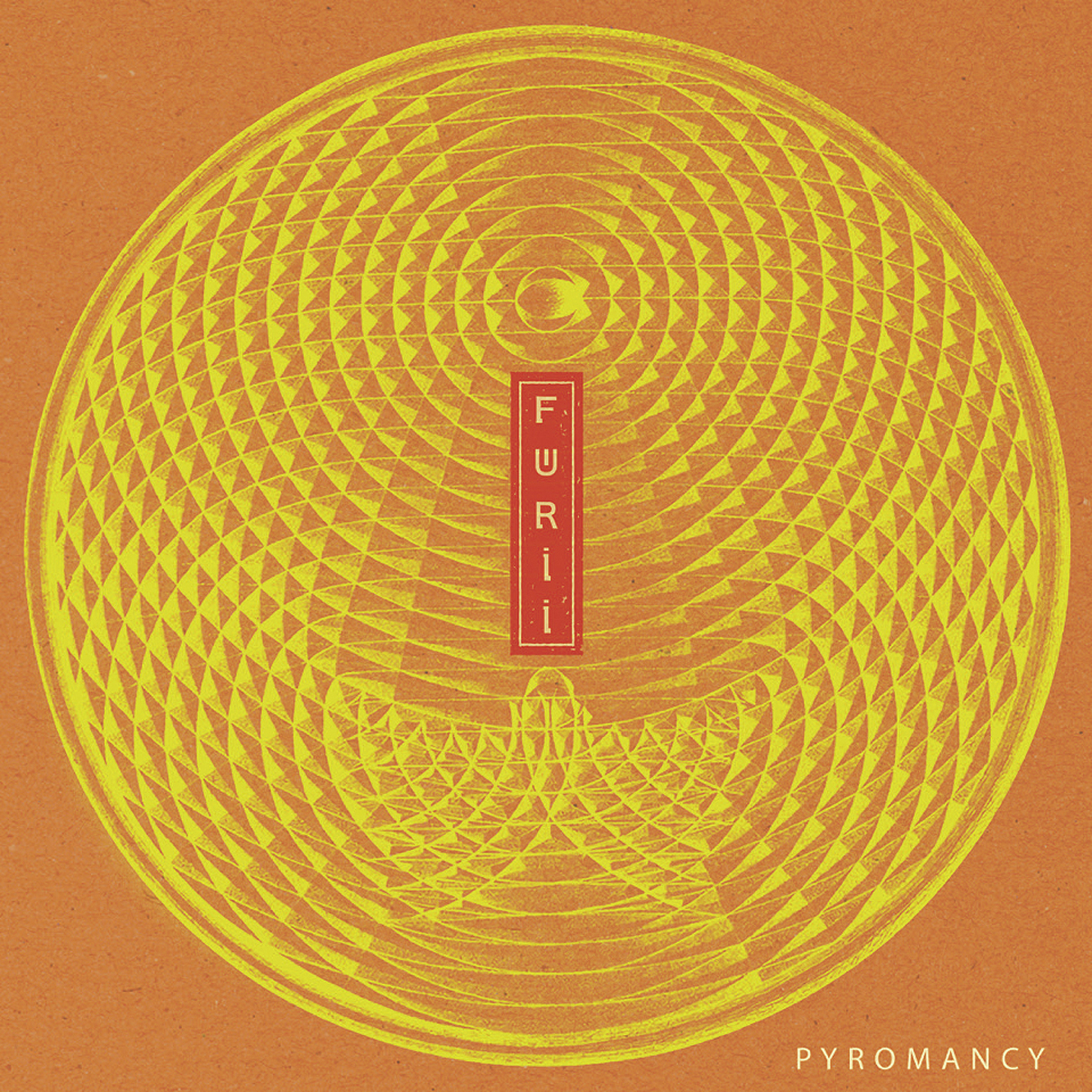
Furii (pronounced fury) is basically multi-instrumentalist Adrien Rodes and a few guests. At times dense, at other times spacious and dreamy. Always fascinating! I dressed in a faux-fur Nehru jacket with lavender goggles and sat in a large neon-lit room with Rodes as he revealed the wonders of Pyromancy track-by-track...
Track 1: Permian
AR: I wanted to start the record with unbound joy, the kind of sound that makes a pigeon puff up its breast feathers. This little cyclical tune came up as I was finishing the record, I liked the fact that it's a little lopsided and have a special affection for songs that shoehorn in an extra chord without concern for the impact on the time signature. Jo Spratley who sings on most of this album came up with the mother of all earworms for this one (Oh yeah!). I would like to take this opportunity to formally apologise for the corkscrew ending.
Track 2: Angle
AR: This one came up and was captured about 30 seconds after getting out of bed. The tune was recorded on my phone, played on an unplugged electric piano in one take. It's totally devoid of any conscious thoughts and does not make one bit of sense. I was really set on not being allowed to change any of its structure, odd chord or timing but overdubbed over the phone demo as it was. Playing the drums to it was way out of my ability but that has never stopped me. I had to write down the time signature of each bar and white knuckle through it somehow. Jo's take on it was just perfect as it is about letting go and embracing a peaceful death. Not bad yoga instruction as I first thought. I love those elongated notes she does at the end.
Track 3: Bark
AR: This was great fun to make, it has a spaghetti western spirit about it and you expect Alessandro Alessandroni to start whistling at every turn. Jo tells me some of the words she sings are from Tim Smith. And what a good story it was. The bass and drums sound like they were tied together and thrown down the stairs, and required an ungodly amount of caffeine. I wish I had a horn section for that last section.
Track 4: Lace
AR: It has minor chords turning to major, harmonic variations and transpositions, it must be clever. It also has some 60s Italian soundtrack DNA. I love what Jo did on this, I won't tell you who this darling raven is but it now means I will forever love this song. The ending with Al Strachan playing the flugelhorn is a direct lift from Spratley's Japs' Fear, which was my favourite song for a long time.
Track 5: Wraith
AR: Originally called Filth because I did not like it. However, it somehow turned a beautiful corner thanks to Jo who gave it some major juju. Playing the bass and the drums on this was probably the bit I enjoyed the most making the record. I wanted Bob Leith to sing on that final second section but we did not get around to it. Al did a great Cornet freakout instead.
Track 6: Floods
AR: The chord sequence popped up while playing the harmonium so it always will always feel like it floats on a cloud gently propelled by giant bellows. Strangely the downward transpositions give it an ascension feeling. I was worried these pitch shifted toppy guitars would be distorting, especially as its the last song on the side but the cutting engineer at the plant clearly know what they are doing. That middle eight after the instrumental verse may seem like an unnecessary complication but you get attached to these things if you are not careful.
Track 7: Peal
AR: Instrumentally, the original idea was to have chords moving under a repeating single note.The inspiration being Maurice Ravel's Le Gibet in Gaspard De La Nuit, one of my favourite pieces of music (pretentious, moi?). Luckily, I did not stick to the brief for very long and Im very pleased with the way the song unfolded organically. Bass, guitar, drums and arpeggiating synths were pretty much all done on the day the song was written, it was a good day.
Track 8: Ilk
AR: I felt the version I had done a couple of years prior could use a dusting off. Having played violin, vibraphone, harmonium and all manners of sped up pianos and Clavinet, things were a little buried on the previous version. I love the flexible tempo on this, again this is due to the song having been built around a guide take recorded on my phone, not to a click or a grid. There are many effects on Jos voice that are barely audible but need to be there, lurking.
Track 9: Radiolaria
AR: This was made using piano I recorded for a Spratleys song called Ripe. These were arpeggio recorded on my battered upright for which I made a mandolin rail, strips of leather with rivets between the hammers and the strings to give it a clink and a buzz. Each arpeggiating chord was slowed down an octave, looped and mapped out on a keyboard. Combining chord arpeggios, triggered slightly out of sync, made it sound like raindrops on a tin roof. I did a few takes of playing this blind, making sure I never learned where each of the chords was and edited my favourite progressions. For some reason what was a really dry metal on metal sound ended up sounding aquatic, with new lifeforms bobbing about.
Track 10: Shallow
AR: Another improvised piece recorded on the guitar in one take, which I then had to furnish without being allowed to alter. The guitar is played through an Echorec with the dry and wet signal sent to different amps which gave it a great stereo on headphones. It was not played to a click or grid but the tempo was mapped to allow synthesiser arpeggio, mostly an old Korg 700s to follow the tempo fluctuation of the master take. As with Radiolaria there are also some sounds from GRM's Atelier. A brilliant software made by the France's Groupe de Recherche Musicale founded by Pierre Shaeffer. It has great oscillators and filters but its main attribute is semi-randomised modulation with different iteration for each of the outputs, it very quickly appears to develop a life of its own.
Track 11: Wizle
AR: There is something very austere about this one which I like. I like the drums through a Leslie sound. Recording Jo for this one was very surreal. it was getting late after doing other songs and we were about to call it a night when I realised it would be our last chance to get something done for that one. She pretty much wrote the lyrics in real time as she did a take and it's probably my favourite. We made a little plainsong choir for this with her son Jesse Cutts and husband Bic Hayes, each of us standing in the corner of the room.The coda nicely resolves into a recall of Permian, to entice you to flip the record over and start it all over again.